


Acelerationism and Consumption
Acelerationism began as a family of arguments about speed as a political strategy: rather than resisting modern techno-capitalism, one should intensify it to bring about systemic transformation.
In contemporary tech discourse, this has mutated into a market-facing ideology of velocity: a set of claims that (a) progress is inherently good, (b) speed is morally and competitively necessary, and (c) caution and regulation are “deceleration” that risks stagnation.
In consumption markets, “accelerationism” is best understood not as a single doctrine but as a cultural-technical regime of tempo that shows up in:
(1) executive/VC rhetoric that normalizes speed as destiny,
(2) platform and marketing practices that engineer urgency (countdowns, drops, flash sales, real-time feeds), and
(3) consumer feelings and behaviors shaped by time scarcity, novelty pressure, and attention competition.
The “experience” is thus dual: consumers are offered genuine convenience and time-saving (e.g., rapid delivery, automated shopping, on-demand entertainment), while simultaneously encountering intensified urgency, rapid churn in offerings, and fatigue from perpetual choice and subscription management. [2]
Empirically, large surveys show persistent subjective time pressure in the background of modern life: Pew reports sizable shares saying they“always feel rushed,” with a pronounced gender/parenting gradient; Gallup finds majorities of working adults reporting insufficient time; and the General Social Survey time-pressure item (“RUSHED”) yields substantial “always” responses in recent waves. [3] Academic work in consumer psychology and behavioral science links time pressure and perceived time scarcity to faster, less deliberative choice, and to strategies that reduce cognitive load (deferring less, relying on heuristics, acting on scarcity cues). [4] In parallel, industry evidence documents commercialization of speed (quick commerce, trend-first commerce, ultrafast fashion) and commercialization of attention (fragmented media landscapes, subscription fatigue).[5]
The most rigorous way to study accelerationism in consumption markets is to treat it as an end-to-end chain:
(A) accelerationist rhetoric and investor incentives → (B) firm operating norms (ship faster, iterate, scale) →(C) market design (product cycles, marketing urgency, platform attention capture) → (D) consumer temporal experience (urgency, novelty-seeking, FOMO, fatigue) → (E) measurable market outcomes (churn, purchase frequency, adoption speed, returns, attention metrics).
Accelerationism is often discussed as if it were one thing, but it is better treated as a cluster concept: multiple positions that share a belief that speeding up socio-technical processes is strategically necessary, while differing on (a) who benefits, (b) what “acceleration”targets, and (c) what “end state” is desired. The 2013 manifesto frames capitalism as structurally tied to acceleration (competition and growth leading to constant technological development), treats some prior accelerationisms (including a “Landian” version) as politically and ethically problematic, and argues for a different “navigational” acceleration. [1]
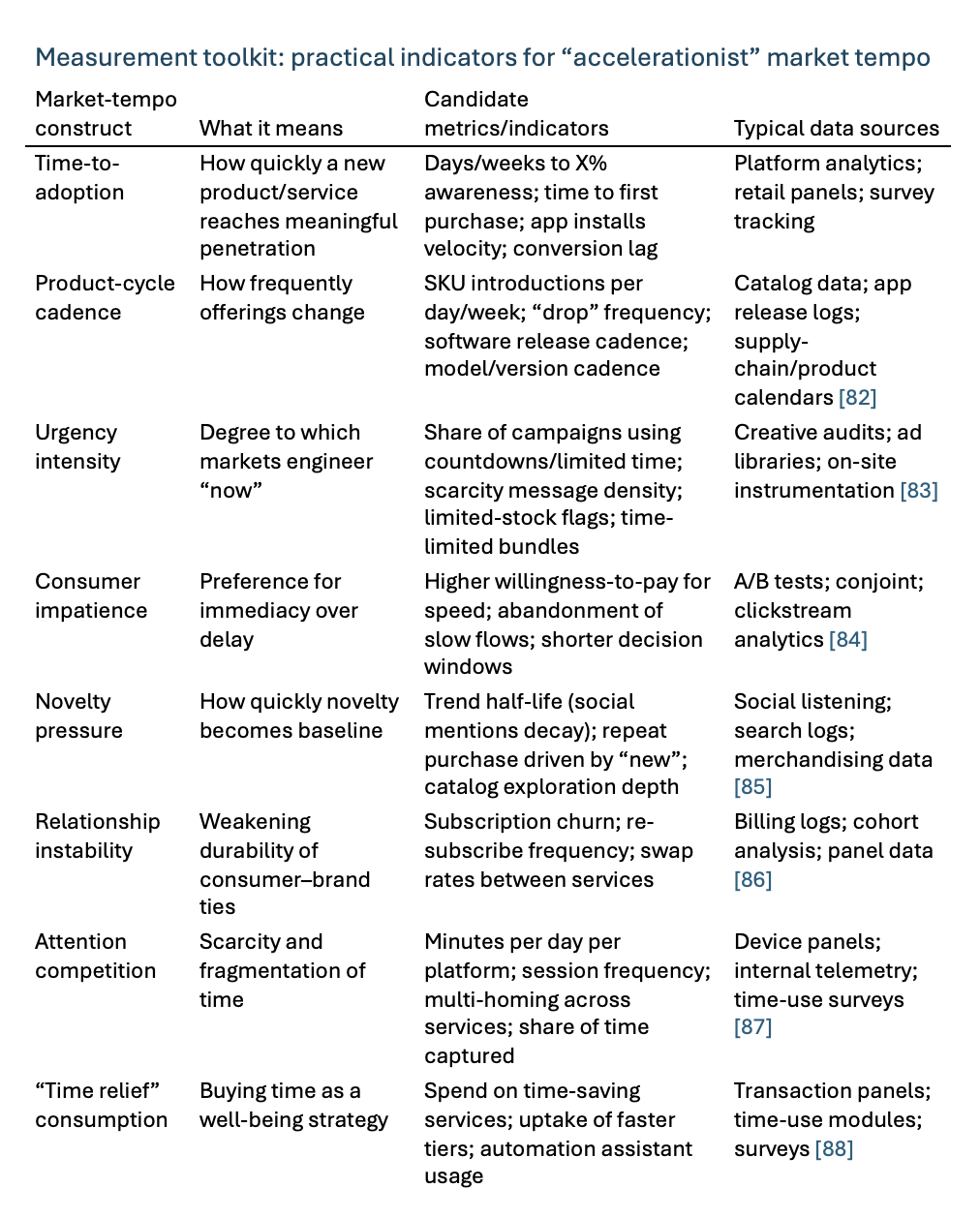
How do we measure accelerationism?
Accelerationism Timeline

1970s : Philosophical debates about capitalism/modernity and speed (later read as accelerationist roots)
1990s : Cybernetic and techno-cultural accelerationist currents become visible in critical theory circles
2003 : "Social acceleration"theorized as multi-domain speed-up (technology, social change, pace of life)
2013 : "#ACCELERATE" manifesto argues for an accelerationist politics; critiques "marginally better consumer gadgetry"
2015 : "Pressed for Time"synthesizes digital capitalism and lived acceleration of everyday life
2023 : Techno-optimist and e/acc discourse gains mainstream visibility through VC-led essays and social identity markers
2024–2025 : Commercial speed intensifies via ultrafast fashion, quick commerce, and attention/subscription competition dynamics
(Each milestone is documented in sources used throughout the report.) [32]
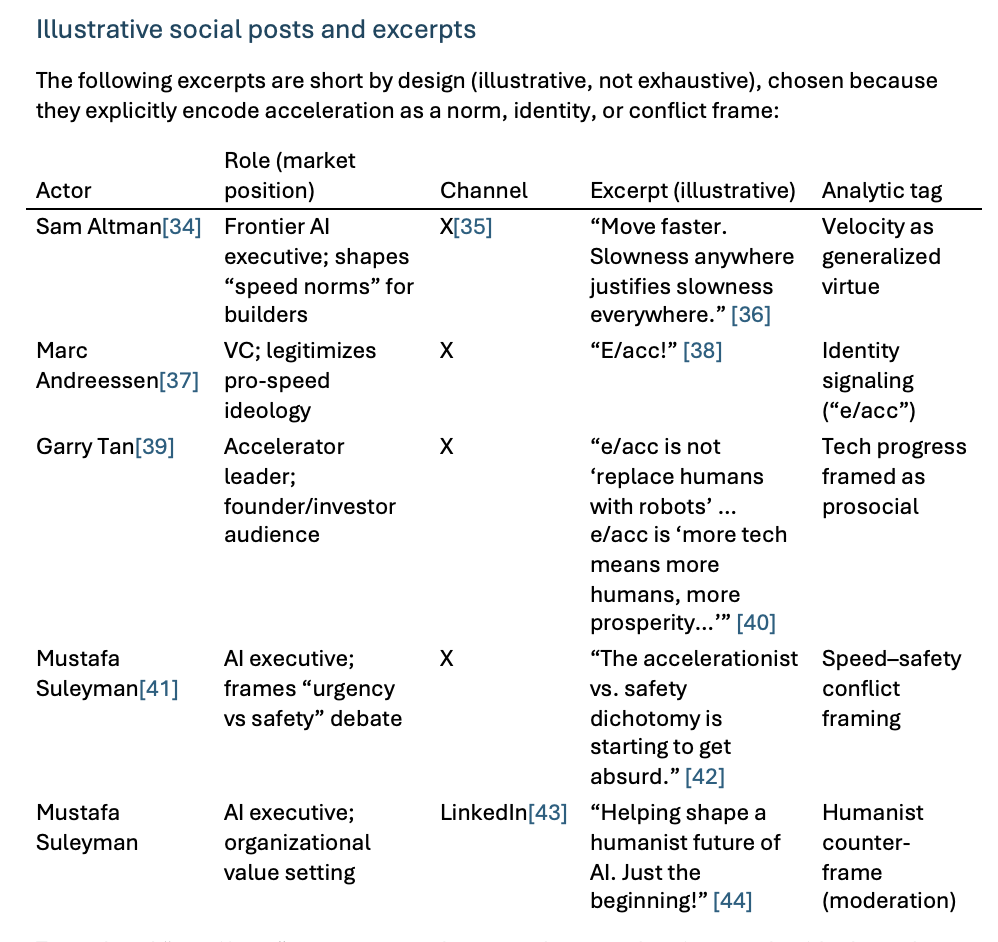
Accelerationist rhetoric as a market signal and a consumption script
How consumers experience time and tempo
To study “the experience of accelerationism” in markets, it is useful to separate objective speed-ups (delivery time, content volume, product release cadence) from subjective time (feeling rushed, urgency, impatience, novelty-seeking) because the latter is what drives many consumer behaviors. [49]
The socio-temporal base layer: social acceleration and “time famine”
Rosa’s“social acceleration” is a high-utility backbone for consumer research because it distinguishes (a) technological acceleration, (b) acceleration of social change, and (c) acceleration of the pace of life—helping explain why faster tools can coincide with stronger time pressure. [24] Wajcman similarly argues that people routinely interpret digital life as accelerating everyday experience, and that busyness is culturally valorized—i.e., tempo is partly a social achievement to be performed, not only a technological imposition. [26]
A marketing/consumer-science synthesis on time shortage emphasizes a key boundary condition: time is finite and nonrenewable, so market innovations that“save time” can backfire by enabling more commitments, more services, and more consumption episodes per day. [50]
Survey evidence: feeling rushed and busy as population phenomena
Large-scale surveys provide a baseline for how common “rushed time” is:
· Pew Research Center[51]reports that substantial shares say they “always feel rushed,” with higher levels for working mothers; this supports the demographic gradient that time pressure is not evenly distributed. [52]
· Gallup [53] finds that working adults are much more likely to report not having enough time than non-working adults, and that having young children increases perceived time pressure. [54]
· The General Social Survey “RUSHED” item (as documented through a major survey archive) shows meaningful “always feel rushed” responses in a recent wave, providing an anchor for time-series research. [55]
· Pew also reports modern-life indicators of busyness and multitasking (e.g., “too busy to enjoy life,” trying to do multiple things at once), consistent with a broader acceleration-of-perceived experience. [56]
Experimental and behavioral evidence: urgency shifts choice architecture
Consumer research repeatedly finds that time pressure changes decision strategy:
· Time pressure reduces consumer willingness to defer choice in certain settings, pushing decisions forward rather than “waiting.” [57]
· A large meta-analysis of scarcity tactics finds that scarcity cues (including time-based scarcity) reliably increase purchase intentions, with heterogeneity by context/product type—useful for mapping where “engineered urgency” is most potent. [58]
· Work on perceived time pressure argues that goal conflict—not just objective schedule density—drives the feeling of being “pressed for time,” implying that modern subscription/service stacks can increase time pressure by increasing goal conflict (more things worth doing than time allows). [59]
FOMO, novelty hunger, and being “always-on”.
Accelerationist consumption is not only “fast”—it is socially comparative and novelty weighted. The Fear of Missing Out (FoMO) construct is explicitly defined asapprehension that others are having rewarding experiences without you, and is empirically linked to social-media engagement patterns. [60] In consumer-market terms, FoMO is a psychological bridge from platform tempo (feeds, drops, real-time visibility) to purchase urgency (limited time offers,“get it before it’s gone”). [61]
“Buying time” as a consumption adaptation.
Acrucial nuance: consumers do not only suffer acceleration; they also purchase relief. A large multi-country study finds that spending money on time-saving services (“buying time”) is associated with higher life satisfaction and demonstrates causal evidence that time-saving purchases can increase happiness relative to material purchases. [62]This matters because accelerationist markets often sell “time” as a premium feature (faster delivery, expedited support, automation assistants), making time relief itself part of the consumption economy. [63]
Market outcomes and indicators in accelerated consumption
Acceleration within consumer markets can be observed through cycletime, attention allocation, and relationship instability (churn, switching, short-lived loyalty). This section links the most visible“fast” sectors (ultrafast fashion, quick commerce, streaming/subscriptions) toa measurement toolkit you can operationalize.
Product-cycle compression and novelty throughput
Ultrafast fashion is a concrete example of acceleration as SKU velocity. Reporting and policy discussion in France [64] highlights “ultra-fast fashion” as characterized by thousands of new itemsdaily, explicitly tying high product turnover and low prices to impulsive buying and constant renewal needs. [65]Independent reporting likewise notes that Shein [66] added thousands of styles per day in 2021, illustrating how novelty throughput can exceed consumers’ ability to form stable preferences. [67]Fashion-industry analysis from Business of Fashion[68]describes how virality and microtrends intensify the speed of fashion conversation and consumption among young shoppers. [69]
This is accelerationism-in-practice: not merely faster logistics, but fastersymbolic turnover—shorter “present” for identity-relevant goods (clothes,beauty routines), consistent with Rosa’s “contraction of the present.” [70]
Commercialization of immediacy: quick commerce
Quick commerce turns speed into the value proposition. In India, a major consulting report (with Bain & Company and Flipkart) describes quick commerce as delivering in under 30 minutes and reports that it now accounts for over two-thirds of e-grocery orders and a meaningful share of overall e-retail spend, projecting rapid growth and category expansion. This same report explicitly pairs quick commerce with “trend-first commerce,” indicating that speed is not only delivery speed but also assortment turnover and launch cadence.
In the U.S., NielsenIQ characterizes the sector as undergoing frenetic change (shifting delivery promises, business-model experimentation, exits), illustrating that acceleration can produce instability and continual redesign of the consumer promise (“10 minutes” → “an hour” → new hybrids).
Subscription fatigue and relationship churn
Acceleration shows up as “relationship instability”: rapid subscribe → prune cycles. Deloitte’s Digital Media Trends report notes that consumers are not necessarily spending more on subscriptions and that many report fatigue managing multiple subscriptions, alongside frustration with rising prices and a fixed budget/time constraint. Zuora’s Subscription Economy Index positions subscription and recurring-revenue business models as a major growth category (based on company data through end-2024) and provides churn benchmarks by industry in explanatory materials, indicating that “subscription” markets structurally depend on retention dynamics.
Attention economy dynamics: the scarce resource is consumer time
Acceleration in consumption markets is constrained by a hard ceiling: attention. Simon’s “poverty of attention” argument formalizes why content abundance and option abundance can increase competition for a scarce cognitive resource, motivating increasingly aggressive engagement engineering. This provides a theoretical bridge from accelerationist rhetoric (“move faster”) to consumer outcomes like impatient switching, shallow evaluation, and subscription churn: when attention is scarce, retention becomes warfare over minutes.
Recommended research builds and concrete data needs
- Discourse-to-design linkage dataset: compile a time-stamped corpus of posts/essays from key actors (VCs, founders, platform heads), then align to firm-level operational metrics (release cadence, campaign urgency share, notification rates). The aim is not sentiment analysis alone, but detecting tempo-imperatives (“move faster,” “accelerate,” “growth or die”) and testing whether they correlate with “speed intensification” in consumer-facing practice.
- Consumer tempo panel: a longitudinal panel combining: (a) subjective time pressure (rushed, multitasking), (b) FoMO and novelty seeking, (c) subscription counts and churn events, (d) purchase frequency and return behavior. This design directly tests whether acceleration is experienced as urgency vs managed as convenience, and for whom.
- Field experiments on urgency and fatigue: randomized exposure to scarcity cues (time-limited vs non-time-limited), but with multi-week follow-up to detect not only conversion uplift but downstream regret, returns, and longer-run churn—capturing acceleration’s potential short-term gains vs medium-term costs. Meta-analytic evidence supports scarcity effectiveness, but durability and backlash are the key open questions.
- Tempo segmentation models for speed-driven sectors: integrate urban form and logistics (delivery promise windows), socioeconomic variables, and household time constraints into propensity models for quick commerce and related “instant” categories—mirroring how consulting reports already treat quick commerce as structurally dependent on density and dark-store access.
- Attention-budget accounting: treat consumer time as a budgeted resource and model substitution (e.g., more short-form video ↔ fewer long sessions; more subscriptions ↔ higher pruning). Simon’s scarcity framing and Deloitte’s “fixed time and money” framing suggest this is the right constraint set for forecasting.
Confidence statement: The report is high confidence on (1) definitional lineage and variant structure of accelerationism, (2) the existence and rhetorical characteristics of contemporary e/acc/techno-optimist discourse, (3) the robustness of time pressure/scarcity effects in consumer behavior, and (4) empirical visibility of accelerated product/delivery/subscription dynamics. It is moderate confidence on precise magnitudes and cross-market generalizability of “consumer impatience” and “novelty pressure,” because these constructs are highly context- and cohort-dependent and are often measured indirectly via platform/proxy metrics rather than standardized survey modules.
References
[1] [7] [13] [14] [25] [32] [45] [71] [72] [79] [97]https://criticallegalthinking.com/2013/05/14/accelerate-manifesto-for-an-accelerationist-politics/
https://criticallegalthinking.com/2013/05/14/accelerate-manifesto-for-an-accelerationist-politics/
[2] [78] [86]https://www.deloitte.com/us/en/insights/industry/technology/digital-media-trends-consumption-habits-survey/2025.html
https://www.deloitte.com/us/en/insights/industry/technology/digital-media-trends-consumption-habits-survey/2025.html
[3] [9] [12] [52] [68] [91]https://www.pewresearch.org/social-trends/2006/02/28/whos-feeling-rushed/
https://www.pewresearch.org/social-trends/2006/02/28/whos-feeling-rushed/
[4] [57] [64] https://www.jstor.org/stable/10.1086/209545
https://www.jstor.org/stable/10.1086/209545
[5] [11] [30] [34] [39] [63] [73] [74] [84] [95]https://www.bain.com/insights/how-india-shops-online-2025/
https://www.bain.com/insights/how-india-shops-online-2025/
[6] [16] [18] [19] [24] [47] [49] [51] [70]https://acceleratedclassroom.wordpress.com/wp-content/uploads/2011/03/social-acceleration.pdf
https://acceleratedclassroom.wordpress.com/wp-content/uploads/2011/03/social-acceleration.pdf
[8] [48] [58] [61] [83] [94]https://www.sciencedirect.com/science/article/pii/S0022435922000434
https://www.sciencedirect.com/science/article/pii/S0022435922000434
[10] [65] [82]https://www.reuters.com/business/retail-consumer/france-mulls-penalties-rein-ultra-fast-fashion-brands-2024-03-04/
https://www.reuters.com/business/retail-consumer/france-mulls-penalties-rein-ultra-fast-fashion-brands-2024-03-04/
[15] [26]https://press.uchicago.edu/ucp/books/book/chicago/P/bo19085612.html
https://press.uchicago.edu/ucp/books/book/chicago/P/bo19085612.html
[17] [53]https://papers.ssrn.com/sol3/Delivery.cfm/5512758.pdf?abstractid=5512758&mirid=1
https://papers.ssrn.com/sol3/Delivery.cfm/5512758.pdf?abstractid=5512758&mirid=1
[20] [23] [29] [66] [81] [87] [96]https://atelierdesfuturs.org/wp-content/uploads/2025/07/1971-simon.pdf
https://atelierdesfuturs.org/wp-content/uploads/2025/07/1971-simon.pdf
[21] [28] [62] [88]https://pmc.ncbi.nlm.nih.gov/articles/PMC5559044/
https://pmc.ncbi.nlm.nih.gov/articles/PMC5559044/
[22] [46] [77] https://a16z.com/the-techno-optimist-manifesto/
https://a16z.com/the-techno-optimist-manifesto/
[27] [41] [89]https://www.abc.net.au/news/2024-02-18/ai-insiders-eacc-movement-speeding-up-tech/103464258
https://www.abc.net.au/news/2024-02-18/ai-insiders-eacc-movement-speeding-up-tech/103464258
[31]https://www.hbs.edu/faculty/Pages/item.aspx?num=56791
https://www.hbs.edu/faculty/Pages/item.aspx?num=56791
[33] [36] [37] [92]https://x.com/sama/status/1345140364995227648?lang=en
https://x.com/sama/status/1345140364995227648?lang=en
[35] [69]https://www.businessoffashion.com/articles/professional/the-state-of-fashion-2024-report-fast-fashion-retail-customer-experience-regulation-shein-temu/
https://www.businessoffashion.com/articles/professional/the-state-of-fashion-2024-report-fast-fashion-retail-customer-experience-regulation-shein-temu/
[38] https://x.com/pmarca/status/1741582291061915870
https://x.com/pmarca/status/1741582291061915870
[40]https://x.com/garrytan/status/1682458510033047552
https://x.com/garrytan/status/1682458510033047552
[42]https://x.com/mustafasuleyman/status/1729860128403239011
https://x.com/mustafasuleyman/status/1729860128403239011
[43] [44]https://www.linkedin.com/posts/mustafa-suleyman_2-weeks-at-mai-an-entire-career-embodying-activity-7419447540418392066-vFQq
https://www.linkedin.com/posts/mustafa-suleyman_2-weeks-at-mai-an-entire-career-embodying-activity-7419447540418392066-vFQq
[50]https://www.bauer.uh.edu/mrrudd/download/TimeShortageReview.pdf
https://www.bauer.uh.edu/mrrudd/download/TimeShortageReview.pdf
[54]https://news.gallup.com/poll/187982/americans-perceived-time-crunch-no-worse-past.aspx
https://news.gallup.com/poll/187982/americans-perceived-time-crunch-no-worse-past.aspx
[55]https://www.thearda.com/data-archive?fid=GSS2016&tab=2
https://www.thearda.com/data-archive?fid=GSS2016&tab=2
[56]https://www.pewresearch.org/short-reads/2020/02/05/how-americans-feel-about-the-satisfactions-and-stresses-of-modern-life/
https://www.pewresearch.org/short-reads/2020/02/05/how-americans-feel-about-the-satisfactions-and-stresses-of-modern-life/
[59]https://papers.ssrn.com/sol3/Delivery.cfm/SSRN_ID2516760_code2174331.pdf?abstractid=2516760&mirid=1&type=2
https://papers.ssrn.com/sol3/Delivery.cfm/SSRN_ID2516760_code2174331.pdf?abstractid=2516760&mirid=1&type=2
[60] [93]https://www.sciencedirect.com/science/article/pii/S0747563213000800
https://www.sciencedirect.com/science/article/pii/S0747563213000800
[67] [75]https://time.com/6247732/shein-climate-change-labor-fashion/
https://time.com/6247732/shein-climate-change-labor-fashion/
[76]https://nielseniq.com/global/en/insights/analysis/2024/everything-you-need-to-know-about-us-quick-commerce/
https://nielseniq.com/global/en/insights/analysis/2024/everything-you-need-to-know-about-us-quick-commerce/
[80]https://www.zuora.com/resource/subscription-economy-index/
https://www.zuora.com/resource/subscription-economy-index/
[85]https://www.businessoffashion.com/articles/marketing-pr/do-viral-microtrends-still-matter-for-fashion/
https://www.businessoffashion.com/articles/marketing-pr/do-viral-microtrends-still-matter-for-fashion/
[90] https://www.bls.gov/tus/
https://www.bls.gov/tus/


.png)


